Summary
Three UN Agencies – UNEP, UNDP and the FAO – have collaborated in the establishment of the UN-REDD programme, a multi-donor trust fund that allows donors to pool resources and provide funding with the aim of significantly reducing global emissions from deforestation and forest degradation in developing countries. Through its nine initial country programme activities in Africa, Asia and Latin America, the UN-REDD Programme supports the capacity of national governments to prepare and implement national REDD strategies with the involvement of all stakeholders.Graphs and statistics
Basic Description
|
Name of Fund |
UN-REDD Programme Fund | ||||||||||||||||||||||||||||||
|
Date created |
Date fund proposed: June 2008 Date fund made operational: September 2008 | ||||||||||||||||||||||||||||||
|
Administrating organisation |
The UN-REDD Programme is a Multi-Donor Trust Fund (MDTF). The UNDP has been appointed as the Administrative Agent for the UN-REDD Programme MDTF. | ||||||||||||||||||||||||||||||
|
Objectives |
Three UN Agencies – UNEP, UNDP and the FAO – have collaborated in this programme, which established a multi-donor trust fund that allows donors to pool resources and provide funding with the aim of significantly reducing global emissions from deforestation and forest degradation in developing countries. | ||||||||||||||||||||||||||||||
|
Donor contributions |
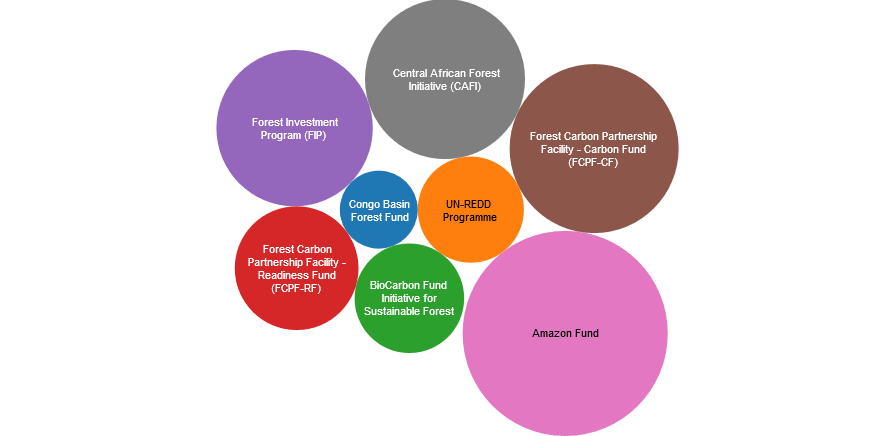
Pledged: As of January 2012, a total of USD 150.84 million has been pledged. Deposited: USD 119.66 million has been deposited as of January 2012, including interest accrued.
(1) 1% administration fee is charged on deposits made to the fund. For clarity we do not show pledges net of this amount. (2) For clarity we do not consider interest received on the fund as having been pledged. | ||||||||||||||||||||||||||||||
|
Activities supported |
The collaborative UN Programme has two components:
(i) Define National / Country Programmes: Assisting developing countries prepare and implement national REDD strategies and mechanisms; and
(ii) Global Programme: Supporting the development of normative solutions and standardized approaches based on sound science for a REDD instrument linked with the UNFCCC. In February 2011, UN-REDD Programme formally launched its first five-year Programme Strategy 2011-2015. This strategy, approved and further guided by the UN-REDD Programme Policy Board in November, provides a necessary roadmap for scaling up critical support to UN-REDD Programme partner countries. National / Country Programmes: The Programme's six work areas are:
A framework to guide development of country programmes is being developed during 20 building on the UN-REDD Programme Strategy for 2011-2015. The framework will identify:
Global Programmes: The UN-REDD Global Programme work is divided in the following seven work areas:
During the sixth meeting in March 2011, a Global Programme Framework to support national REDD+ actions, also building on the Programme Strategy for 2011-15, was finalised; in August 2011 the UN-REDD Programme Policy Board inter-sessionally endorsed and approved the final version of the UN-REDD Programme's "Support to National REDD+ Action-- Global Programme Framework 2011-2015". | ||||||||||||||||||||||||||||||
|
Conditions and eligibility requirements |
Countries were selected for phase I (the pilot phase) according to the following criteria:
Guidance on how each criterion was judged, and how REDD readiness potential was assessed, is not publicly available. During the sixth Policy Board meeting, the following criteria were proposed for prioritizing funding allocations for new National Programmes:
| ||||||||||||||||||||||||||||||
|
Funds disbursed to date |
As of January 2012 the total amount approved is USD 108.13 million. Of this, USD 90.91 million has been disbursed. | ||||||||||||||||||||||||||||||
|
Uptake and projects supported |
A full list of projects is available here: http://www.climatefundsupdate.org/projects
As of January 2012, the UN REDD Programme has partnerships with 42 countries in total, (list of countries reported under 'Fact Box': http://www.un-redd.org/Newsletter25/7_New_Countries/tabid/78563/Default.aspx ), 14 of which have received funding allocations for National Programmes. Of these 14, Cambodia, Papua New Guinea, the Philippines, Paraguay, Solomon Islands and Nigeria recently signed their National Programme documents, and now join the seven other UN-REDD Programme partner countries already in the implementation phase of their National Programmes. Only one country has not yet entered in the implementation phase. New partner countries can benefit from receiving targeted support from the UN-REDD Global Programme and knowledge sharing. Partner countries will also have observer status at UN-REDD Programme Policy Board meetings, and may be invited to submit a request to receive funding for a National Programme in the future, if selected through a set of criteria to prioritize funding for new countries approved by the Policy Board. | ||||||||||||||||||||||||||||||
|
Proposed life of fund |
Unknown. | ||||||||||||||||||||||||||||||
|
Further information |
|
Fund Governance
|
Decision-making structure for fund disbursement |
The UN-REDD Programme is intended to facilitate and streamline the provision of donor resources to UN Joint Programmes to implement REDD activities at country level. The UN-REDD Programme Policy Board provides overall leadership and sets the strategic direction of the UN-REDD Programme. It decides on Programme financial allocations, in line with the budget parameters set out in the UN-REDD Programme Framework Document, and develops monitoring mechanisms, with a view to ensuring Fund-wide success. The UN-REDD Programme Policy Board will ensure coordination with REDD actors at a global scale, such as the World Bank’s FCPF participants’ committee. It will include representation of major stakeholder groups. The UN-REDD Programme Secretariat serves the Policy Board, using the capacities of the participating UN organizations, research institutions and recognized experts. It ensures policies and strategies decided by the Policy Board are implemented and adhered to. The Secretariat will manage the national joint programme review process. It will also manage the UN-REDD Programme’s overall monitoring and evaluation function which includes inter alia monitoring allocations to and delivery by the international support functions and country joint programmes, and tracking Programme-wide progress and ensuring that monitoring mechanisms are applied. It will include independent third party verification/evaluation of emission reductions, an on-line review and comment process, and an ombudsman system for complaints. The UN-REDD Programme will be implemented through joint national programmes for country actions and global programmes for international support functions (hereinafter referred to as “Programme Documents”), as set out in the main text. While these programmes will be implemented by FAO, UNDP and/or UNEP, it is recognized that close coordination and participation with other REDD actors will be critical. The UN-REDD Programme is not an exclusive UN mechanism. National governments, Regional Development Banks and NGOs can receive funding through a participating UN organization and act as executing agencies. In addition, UN-REDD Programme will consult and coordinate closely with other relevant REDD initiatives and donors, particularly the World Bank, the GEF and bilaterals. Administration of the UN-REDD Programme MDTF is entrusted to the Multi-Donor Trust Fund (MDTF) Office of UNDP, as the Administrative Agent who serves as the administrative interface with donors. UNDP’s accountability as the Administrative Agent is set out in the policy "UNDP’s Accountability when acting as Administrative Agent in MDTFs and/or UN Joint Programmes using the pass-through fund management modality". Participating UN organizations, in this case FAO, UNDP and UNEP, assume full programmatic and financial accountability for the funds received from the Administrative Agent. The UNDP MDTF Office is the Administrative Agent of the Fund. The MDTF Office manages the distribution of resources and oversees the work of UNDP Country offices that may be involved in the provision of Administrative Agent function at the country level. The MDTF Office as AA will is responsible for:
The Administrative Agent may undertake additional functions at the request of the Participating UN Organizations. The Administrative Agent will charge a one time fee of 1 per cent for fund administration and fiduciary responsibilities which will be provided in advance on the basis of Programme Documents budgets approved by the Policy Board. The UN-REDD Programme will be supported by UN Resident Coordinators in their strategic leadership of the UN Country Team and relationships with national authorities. The UN Resident Coordinator will provide ongoing oversight to the joint programme at the national level, ensuring the participating UN organizations are meeting their obligations. The Resident Coordinator is entrusted with supporting the overall programme design under the government’s leadership, ongoing programmatic oversight of the UN-REDD Programme activities and UN coordination with the National REDD Office where such exist. The Resident Coordinator also facilitates ongoing monitoring and evaluation of the UN-REDD Programme activities in conformity with UN standards. On receipt of consolidated country level reports, the Resident Coordinator will provide an overall assessment of the programme’s progress and results. He/she will also facilitate ongoing monitoring and evaluation of Fund-supported activities in conformity with UN standards and any guidance provided by the UN-REDD Programme Secretariat or Policy Board. Each Participating UN Organization shall assume full programmatic and financial accountability for the funds disbursed to it by the Administrative Agent. Each Participating UN Organization shall establish a separate ledger account for the receipt and administration of the funds disbursed to it by the Administrative Agent. The Participating Agencies participate in the design, ongoing programmatic implementation and oversight of the country Joint Programme. Participating UN Organizations shall be entitled to deduct their indirect costs on contributions received according to their own regulations and rules, taking into account the size and complexity of the particular programme. Any indirect costs will be reflected in the Joint Programme submitted to the Secretariat. Indirect costs will not exceed 7 per cent of the project budget. A National REDD Steering Committee mechanism will be established to provide operational coordination to the Joint Programme and integration under the UNDAF thematic structures in place at the country level. The establishment of a country-led National REDD Office will be encouraged to provide day-to-day management of the Joint Programme, coordinate national REDD activities, ensure whole-of-government responses, and integrate REDD into national development planning processes. Resident Coordinators are encouraged to keep Country Team members fully-informed on UN-REDD Programme activities. Involvement of the Government in the deliberations concerning the Fund-related activities in the country is also crucial. The UN-REDD Programme also looks to Resident Coordinators to reach out to NGOs, CSOs, national governments and non-resident UN agencies, where appropriate. Activities supported by the UN-REDD Programme at the country level are expected to take the form of Joint UN Programmes whereby multiple UN organizations collaborate around a common programmatic goal. Funds will be channelled to individual organizations to meet their commitments to the Joint Programme, through the Administrative Agent. (Multi Donor Trust Fund Gateway) |
|
Consultations with non-government stakeholders |
According to the official website of the UN-REDD programme (www.un-redd.org), initial consultations with Indigenous Peoples were held throughout 2008 during various international meetings and conferences and the Programme will continue to engage with Civil Society and Indigenous People through a series of global and regional consultation workshops throughout the implementation phase. This is currently reflected by the ongoing Free, Prior and Informed Consent (FPIC) consultation process based on input from Asia-Pacific, Latin American, Caribbean and African regions (for recent details, see http://www.un-redd.org/Newsletter16/Tanzania_FPIC/tabid/51395/Default.aspx). Indigenous Peoples (IPs) and Civil Society (CSOs) are represented on the 19 seats of the Policy Board of the UN-REDD Progamme by the seat for Indigenous Peoples (IPs) - which is held by the Chair of the United Nations Permanent Forum on Indigenous Issues (UNPFII) on a non-rotational basis - and the seat for Civil Society (CSOs). In addition, the 29 observers at Policy Board meetings include three representatives each, from IPs and CSOs. Rules on membership and rotation of seats on the Policy Board were undergoing review as of May 2011. In 2009, the Programme drafted and built consensus for the UN-REDD Operational Guidance on the Engagement of Indigenous Peoples and other Forest Dependent Communities, and supported national UN-REDD programmes to fully engage stakeholders. The Programme has also made progress towards harmonizing the UN-REDD approach to engagement with the FCPF approach. The good practice of engaging stakeholders in the DRC was documented and widely disseminated, and the programme has developed recommendations on FPIC and recourse mechanisms. Between October and December of 2011, the UN-REDD program has invited the public to comment on the 'UN-REDD Programme Draft Social and Environmnetal principles'. At the Panama Climate Change Conference in October 2011, the UN-REDD Programme launched its report on the definitions of scenarios for implementation of REDD+. The work involves a multidisciplinary team of experts in the areas of economics, forestry, statistics, Geographic Information Systems, rural development and modeling. It is intended to assist policy makers in defining options for implementation of REDD+ that can fully take into account environmental and social benefits. The objective is not just to maximize monetary flows from carbon payments, but to realize the vast range of environment and social benefits that forests can provide. |
|
How fund disbursement is reported |
In 2009, the Multi Donor Trust Fund (MDTF) office developed the MDTF Office GATEWAY, a knowledge platform combining easy access to more than 4000 relevant reports and documents, with tools and tables dis-playing financial data in real-time from the MDTF Office accounting system on donor contribu-tions and transfers to the Participating UN Organizations. It is designed to provide transparent, accountable fund-management services to the United Nations system to enhance its coherence, effectiveness and efficiency and can be found on http://mdtf.undp.org. |
|
Issues raised by the public |
According to a briefing note from FERN - Forests and the European Union Resource Network (Available at http://www.fern.org/media/documents/document_4316_4321.pdf), the initiative was launched without consultation with any civil society organisations. According to Griffiths (reference below), the public criteria for Phase I Pilot countries should include governance and human rights criteria. The same author points out that while being commended for adopting a rights-based approach to REDD, civil society organisations are concerned that the UN agencies concerned do not have binding policies or, if they do possess such policies, the mechanisms for their application are weak. In addition, Griffiths mentions further criticisms, such as the lack of clear measures to address social risks of REDD policies, the flawed UN land use category definitions, and the role of the UN in pushing the carbon market to finance REDD before decisions have been taken in the UNFCCC. |
Relationship with Official Development Assistance
|
Is donor funding considered part of official development assistance? |
Yes. |
|
Financial instrument/ delivery mechanism used (e.g. grant, loan) |
Grants. |
|
Nature of recipient country involvement |
National actions will be identified and led by the host government and supported by the UN Country team. In August 2011 the UN-REDD Programme Policy Board endorsed the UN-REDD Global Programme Framework document: “Support to National REDD+ Action-- Global Programme Framework 2011-2015” with a budget of US$51.5 million over two years. It looks at the critical areas of REDD+, including how REDD+ can achieve broader social environmental and economic development strategies. The document shows the Programme commitment to supporting country led efforts and states that, “the central goal of the UN-REDD Programme’s National and Global Programmes is to support the efforts of partner countries to develop and implement REDD+ strategies. It is at this country level that the REDD+ concept is taking shape and making the most tangible inroads.” A major engagement between the UN-REDD programme agencies (FAO, UNDP and UNEP) and partner countries to understand their needs and expectations has been crucial for achieving this endorsement. Activities under the Global Programme directly support partner countries in the design of their national REDD+ strategies that can be presented to the UN-REDD Programme Policy Board for additional financial and technical support through UN-REDD National Programmes. The Framework provides technical support to countries in six interlinked work areas: |
|
Overall consistency with the aid effectiveness agenda (i.e. the Paris Declaration) |
The UN REDD fund main objective is to assist developing countries prepare and implement national REDD strategies and mechanisms. The programme therefore aims to help empower countries to manage their REDD processes and facilitate access to financial and technical assistance tailored to the specific needs of the countries. |