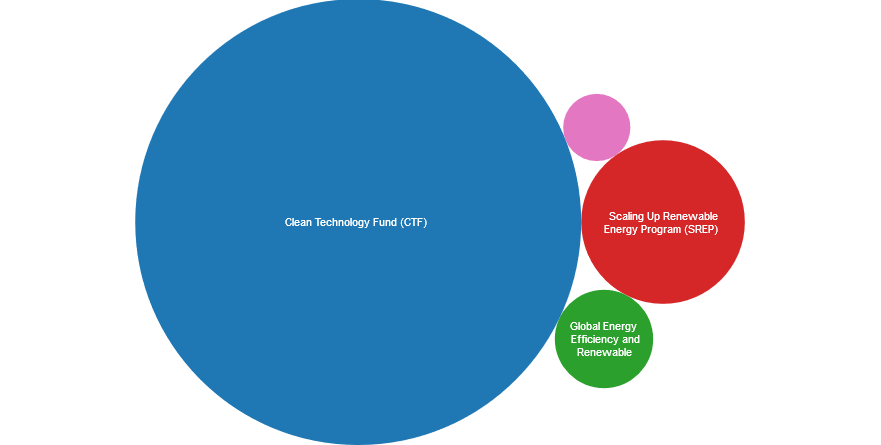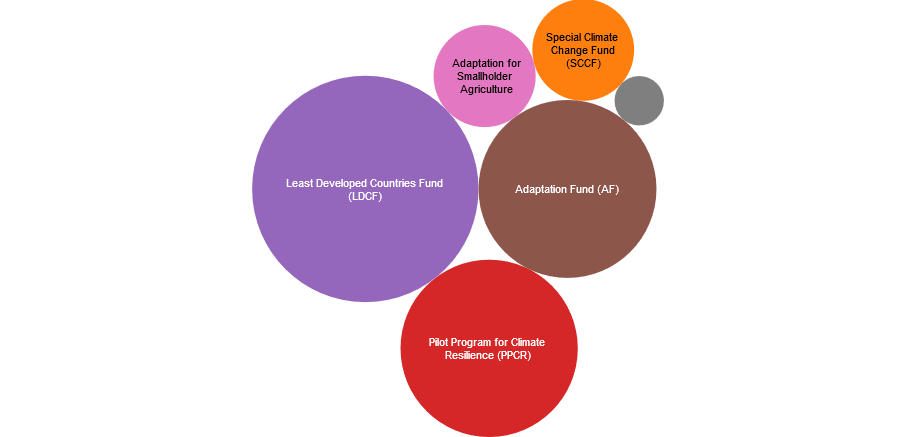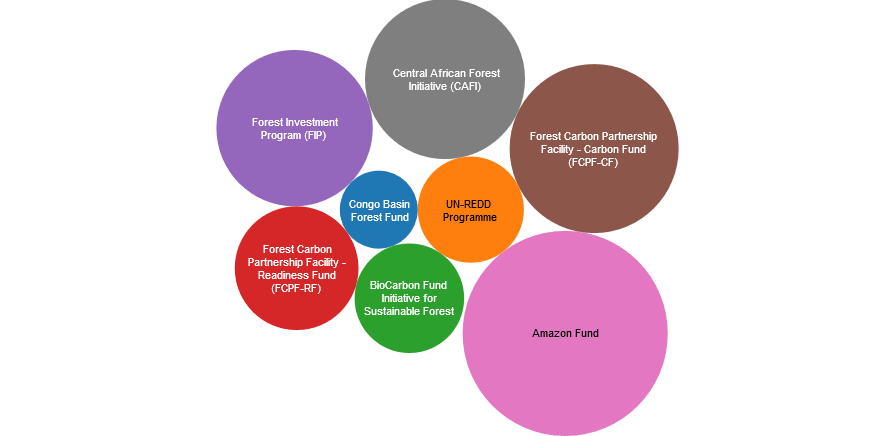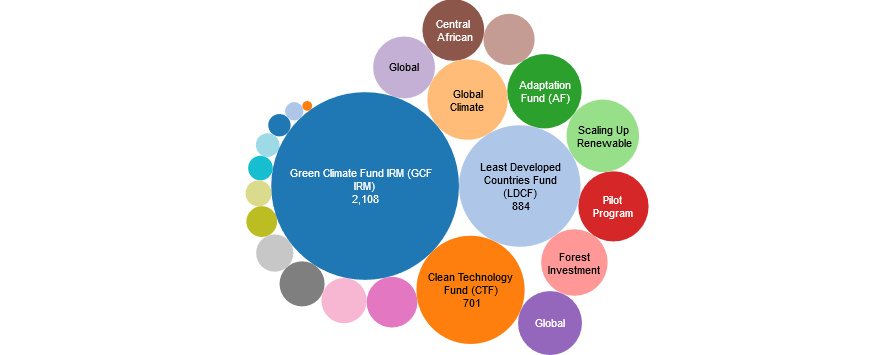
Summary
Basic Description
|
Name of Fund |
Strategic Climate Fund (a multi-donor Trust Fund under the umbrella of the World Bank-managed Climate Investment Funds) |
|
Date created |
Date fund proposed: The Fund was first proposed in February 2008. On May 30, 2008, in Potsdam, Germany, the multilateral development banks (MDBs), developed and developing countries and other development partners reached an agreement on the design and establishment of the SCF.
Date fund made operational: Approved by Executive Directors of the World Bank on July 1, 2008, with a donors pledge meeting on September 26, 2008. |
|
Administrating organisation |
African Development Bank, Asian Development Bank, European Bank for Reconstruction and Development, Inter-American Development Bank, World Bank |
|
Objectives |
The Strategic Climate Fund (SCF) is one of the two (along with the Clean Technology Fund) multi-donor Trust Funds within the Climate Investment Funds (CIF). The SCF is quite broad and flexible in its scope and will serve as an overarching fund for various programs to test innovative approaches to climate change. The SCF is an umbrella vehicle for the receipt of donor funds and disbursements to specific funds and programmes aimed at piloting new development approaches or scaling up activities aimed a specific climate change challenge or sectoral response.
The objectives of the SCF are to: (a) promote international cooperation on climate change and support progress towards the future of the climate change regime; (b) provide experience and lessons in responding to the challenge of climate change through learning-by-doing; (c) promote and channel new and additional financing for addressing climate change through targeted programs to be established as part of the SCF or through separate funds like the CTF or other funds addressing climate change, such as the Forest Carbon Partnership Facility; (d) utilize the skills and capabilities of the MDBs to raise and deliver concessional climate financing at a significant scale to unleash the potential of the public and private sectors to achieve meaningful reductions of carbon emissions and greater climate resilience; (e) provide incentives for scaled-up action and transformational action (both mitigation and adaptation) and for solutions to the climate change challenge and poverty reduction in developing countries, consistent with poverty reduction and sustainable development strategies that are robust to climate change; (f) provide incentives to maintain, restore and enhance carbon-rich natural ecosystems to prevent these carbon sinks from becoming sources of increased emissions, and to enhance all the services they provide, including climate resilience or adaptive capacity, and thereby support sustainable development; (g) complement other multilateral financial mechanisms, such as the Global Environment Facility (GEF) and the Adaptation Fund, and bilateral sources of financing and seek co-financing where appropriate; and
(h) maximize co-benefits of sustainable development, particularly in relation to the conservation of biodiversity, natural resources ecosystem services and ecological processes. |
|
Donor contributions |
|
Country |
Contribution Type |
Pledges (millions) |
Currency |
|
Australia |
Grant |
50 |
AUD |
| Canada |
Grant |
100 |
CAD |
| Denmark |
Grant |
130 |
DKK |
|
Germany |
Grant |
50 |
EUR |
|
Japan |
Grant |
200 |
USD |
|
Netherlands |
Grant |
54.4 |
EUR |
|
Norway |
Grant |
176 |
USD |
|
Switzerland |
Grant |
20 |
USD |
|
UK* |
Capital |
200 |
GBP |
|
United States |
Grant |
20 |
USD |
| Total |
|
2.0 Bn |
USD eq. | *UK's pledge includes allocation of GBP 385 million to the Clean Technology Fund, GBP 3.5 million to Readiness Fund of the Forest Carbon Partnership Facility (FCPF), GBP 11.5 million to Carbon Fund of the FCPF, and GBP 50 million to the Congo Basin Fund.
Within the SCF, the pledges are allocated as to the following programs (details of the programs are described in the 'Activities Support' section below).
Pilot Program on Climate Resilience (PPCR)
The PPCR is currently the only targeted program officially established under the SCF;
|
Country
|
Contribution Type |
Pledges(in millions) |
Currency |
| Australia |
Grant |
40 |
AUD |
|
Canada |
Grant |
100 |
CAD |
| Germany |
Grant |
50 |
EUR |
| Japan |
Grant |
50 |
USD |
| United Kingdom |
Capital |
225 |
GBP |
| Total |
|
614 |
USD eq. |
Forest Investment Program (FIP)
|
Country
|
Contribution Type |
Pledges(in millions) |
Currency |
| Australia |
Grant |
10 |
AUD |
| Denmark |
Grant |
10 |
USD |
| Norway |
Grant |
150 |
USD |
| UK |
Capital |
100 |
GBP |
| United States |
Grant |
20 |
USD |
| Total |
|
330 |
USD Eq. |
Unallocated: Japan has pledged USD 150 which is unallocated. Denmark has DKK 79.2 unallocated.
Deposited: As of September 30, 2009, the Trustee has entered into Contribution Agreements with Canada, the United Kingdom and Australia. The Trustee received CAD 85 million in cash from the Government of Canada, GBP 300 million from the Government of the United Kingdom, and 35.9 AUD from the Government of Australia.
Funding Decisions: The cumulative funding decisions made by the SCF Trust Fund Committee amount to approximately USD 20 million, of which USD 7 million represents the Country Programming budget approved as part of the CIF Administrative Budget—USD 4 million for the PPCR, USD 2 million for the FIP and USD 1 million for the SREP. The SCF Trust Fund Committee approves allocation of SCF resources for administrative budget, while the SCF Sub-Committees approve SCF financing for programs and projects under the respective targeted programs. Table 2 shows the cumulative funding decisions made at the SCF level and specifically for the PPCR, the FIP and the SREP. |
|
Activities supported |
Within the framework of the SCF, targeted programs with dedicated funding (known as the ‘SCF Programs’) are being established to provide financing to pilot new development approaches or scaled-up activities aimed at a specific climate change challenge or sectoral response.
The Pilot Program for Climate Resilience (PPCR) is the first Program under the SCF. It will provide incentives for scaled-up action and transformational change through pilot projects that demonstrate ways to integrate climate risk and resilience into core development planning, while complementing other ongoing development activities in a given country.
The Forest Investment Program, will mobilize significantly increased investments to reduce deforestations and forest degradation and promote improved sustainable forest management, leading to emission reductions and the protection of carbon reservoirs.
The Program for Scaling-Up Renewable Energy in Low Income Countries (SREP), is within the framework of the Strategic Climate Fund (SCF). The SREP will demonstrate the economic social and environmental viability of low carbon development pathways in the energy sector by creating new economic opportunities and increasing energy access through the use of renewable energy.
SCF Programs in addition to those listed above may be considered in accordance with the following criteria:
• Multiple donor interest in establishing a SCF Program; • Broad applicability of lessons to be learned; • Sufficient resources to finance activities at scale; • Complementary to any other multilateral financial mechanism or initiative; and • Link between climate change and development.
Significant progress has been made on the three sub-programs of the SCF. See detailed descriptions of each of the funds on this website: http://www.climatefundsupdate.org/listing/pilot-program-for-climate-resilience http://www.climatefundsupdate.org/listing/forest-investment-program http://www.climatefundsupdate.org/listing/scaling-up-renewable-energy-program
|
|
Conditions and eligibility requirements |
Criteria for eligibility of recipient countries will be established by each of the SCF Program Sub-Committees.
ODA-eligible countries that have an active MDB country program may access the CIF. Guidelines for accessing financing are finalized by the program sub-committees or through the respective multi stakeholder design process. Implementation will be undertaken utilizing the core processes of the MDBs.
While the Trust Fund Committee or sub-committees may decide on the programming priorities and financing modalities for the SCF, the development and management of individual funded projects and programmes will be country-led. |
|
Funds disbursed to date |
See individual programs under the SCF.
http://www.climatefundsupdate.org/listing/pilot-program-for-climate-resilience
http://www.climatefundsupdate.org/listing/forest-investment-program
http://www.climatefundsupdate.org/listing/scaling-up-renewable-energy-program |
|
Uptake and projects supported |
See individual programs under the SCF.
http://www.climatefundsupdate.org/listing/pilot-program-for-climate-resilience
http://www.climatefundsupdate.org/listing/forest-investment-program
http://www.climatefundsupdate.org/listing/scaling-up-renewable-energy-program |
|
Proposed life of fund |
"sunset clause"
The fund is an interim measure for the MDBs to fill an immediate financing gap and therefore includes a specific sunset clause linked to the agreement on the future of the climate change regime. Pending final agreement on the future of the climate change regime, the SCF will provide financing to pilot new approaches with potential for scaled-up, transformational action aimed at a specific climate change challenge or sectoral response. |
|
Further information |
1. Strategic Climate Fund document, June 3, 2008 : http://siteresources.worldbank.org/INTCC/Resources/Strategic_Climate_Fund_final.pdf
2. Governance Framework of the SCF, November 13, 2008: http://siteresources.worldbank.org/INTCC/Resources/SCFgovernanceframeworkrevisednov13.pdf
3. Trustee Report, Financial Status of the CIF, November 17, 2008: http://tinyurl.com/ahd5up
4. Development of new targeted programs under SCF (SREP and FIP) from January 27, 2009 SCF Trust Fund Committee meeting: http://siteresources.worldbank.org/INTCC/Resources/Developmentofnewtargetedprograms-Jan16.pdf
5. World Bank proposal for NGOs as observers to the SCF, from the January 27, 2009 SCF Trust Fund Committee meeting: http://siteresources.worldbank.org/INTCC/Resources/SECPaperNGOobservers_v2.pdf . The paper largely draws from a larger document prepared by the IUCN, available here http://siteresources.worldbank.org/INTCC/Resources/Review_of_Practices_NGO-CSO_Particiaption_Final.pdf
6. Sharing Lessons with the UNFCCC (Submitted by the Trust Fund Committee member from the UK) – proposal from the January 27, 2009 SCF Trust Fund Committee Meeting: http://siteresources.worldbank.org/INTCC/Resources/SCF-Sharing_lessons_with_UNFCCC-UK.pdf
8. CIF Trustee Information Note, January 2009. This can be accessed in the January 27-30, 2009 CIF Trust Fund Committee meeting documents: http://go.worldbank.org/K1EFE6E230
|
Fund Governance
|
Decision-making structure for fund disbursement |
The decision-making structure of the SCF is made up of the SCF Trust Fund Committee, and SCF Sub-Committee(s) for each program.
The SCF Trust Fund Committee is comprised of:
a. eight representatives from contributor countries (or groups of such countries) making the minimum contributions to the SCF (determined through a consultation among contributor countries and will be notified to the Administrative Unit and the Trustee), identified through a consultation among such contributors (or potential contributors in respect of the first year of the SCF operations);
b. eight representatives from potential recipient countries (or groups of such countries), identified through regional consultations among interested ODA-eligible recipient countries with MDB country programs;
c. a senior representative of the World Bank (non-voting), recognizing the role of the World Bank as the overall coordinator of the CIF partnership; and
d. a representative of the MDBs (non-voting), identified by the MDB Committee for each meeting of the SCF Trust Fund Committee on the basis of rotation among the MDBs.
The SCF Trust Fund Committee is responsible for approving establishment of SCF Programs and the scope and objectives governing the use of the funds under the SCF Programs; ensuring that the strategic orientation of the SCF is guided by the principles of the UNFCCC; establishing a SCF Sub-Committee for each SCF Program and designating members; approving allocation of SCF resources for administrative budgets; etc.
Decision by the SCF Trust Fund Committee will be made by consensus of the voting Members. If consensus is not possible, then a proposed decision will be postponed or withdrawn.
The SCF Trust Fund Committee will establish a SCF Sub-Committee for each of the SCF Programs. Each Sub-Committee will consist of:
- Up to six representatives from contributor countries to the SCF Program (with at least one of Member of the SCF Trust Fund Committee);
- Matching number of representatives from eligible (meeting criteria for funding under the concerned SCF Program) recipient countries to the SCF Program, with at least one Member of the SCF Trust Fund Committee.
- Such other representatives designated by the SCF Trust Fund Committee for this purpose.
The functions of each SCF Sub-Committee will include approving programming priorities, operational criteria and financing modalities for the SCF Program; approving SCF Program financing for programs and projects; ensuring complementary between activities foreseen for the SCF Program and activities of other development partners active in the field of climate change, including the GEF and the UN, and ensuring effective cooperation between the SCF Program and the GEF and UN country activities to maximize synergies and avoid overlap.
In addition to the SCF Trust Fund Committee and the SCF Sub-Committee(s), the governance and organizational structure of the SCF includes a Partnership Forum, an MDB Committee, an Administrative Unit and a Trustee.
The Partnership Forum is a broad-based meeting of stakeholders of the CIF, including contributor and eligible recipient countries, MDBs, United Nations organizations, GEF, UNFCCC, the Adaptation Fund, bilateral development agencies, non-governmental organizations, private sector entities, and scientific and technical experts.
The MDB Committee facilitates collaboration, coordination and information exchange among the MDBs.
The Administrative Unit supports the work of the CIF, including the SCF, and the SCF Trust Fund Committee, SCF Sub-Committees and other bodies of the CIF. The Administrative Unit will be housed in the Washington, D.C. offices of the World Bank and comprised of a small team of professional and administrative staff employed by the World Bank.
The IBRD will serve as Trustee for the SCF. IBRD, in its capacity as the Trustee, will establish a trust fund for the SCF (the Trust Fund) to receive contributions from contributors to the SCF, and will hold in trust, as a legal owner, and administer the funds, assets and receipts that constitute the Trust Fund.
|
|
Consultations with non-government stakeholders |
In designing the Climate Investment Funds, consultations took place with potential donors and recipients, the United Nations family, other multilateral development banks (MDBs), civil society organizations, and the private sector. At a final design meeting, held in Potsdam, Germany, on May 21-22, 2008, representatives from some 40 developing and industrialized countries agreed to create the CIF.
The challenge in the first year was translating the cooperative effort of the design process to an inclusive operational structure. Decision-making and disclosure were problematic at the beginning. But as time went on, Trust Fund Committee members agreed on the need for developing a formal role for other stakeholders as observers. The design of the self-selection process was based on independent advice (from non-governmental organizations (NGOs) and the private sector) and using best practices from other organizations. The NGO and private sector observers met for the first time at the October 2009 meetings. A self-selection process for Indigenous Peoples observers awaits approval.
The Fund includes a Partnership Forum – a broad-based meeting of stakeholders, including donor and eligible recipient countries, MDBs, UN and UN agencies, GEF, UNFCCC, the Adaptation Fund, bilateral development agencies, NGOs, private sector entities, and scientific and technical experts. The group will be convened annually to provide a forum for dialogue on the strategic directions, results and impacts of the CIF. The Partnership Forum will be co-chaired by the World Bank Vice President for the Sustainable Development Network and a country representative elected by countries participating in the Partnership Forum.
The Partnership Forum will be a meeting for dialogue and consultation and will not lead to written outcomes, such as agreed texts or declarations, which could be used as a basis for discussions in the UNFCCC. The next Partnership Forum is to be held in March 2010 in Manila, Philippines |
|
How fund disbursement is reported |
Accounting and reporting of donor contributions and fund allocations is still under discussion, according to the Trustee Report from November 17, 2008.
Disclosure policy
In May 2009, the Trust Fund Committees approved a disclosure policy that calls for country-owned investment plans and strategies developed under each of the Trust Funds to be disclosed in-country prior to their submission to a CIF Committee for approval. Proposed plans are also posted on the CIF website no later than 3 weeks prior to review of the proposal by a Committee. In the case of proposed programs and projects, an information document describing the proposal is to be made public at least two weeks prior to a decision on the funding of the proposal. The policy recognizes that a country or a project proposer may have justifiable reasons for not publicly disclosing all information in an investment plan or project. In this case, certain information may be kept confidential. This is to be done only on an exceptional basis, and non-disclosure of information is to be justified to the Committee. |
|
Issues raised by the public |
The SCF has been criticised by certain civil society groups for creating parallel structures for financing climate change adaptation and mitigation outside the ongoing multilateral framework for climate change negotiations and within a process dominated by G8 countries. Developing countries have long argued for greater commitments and increases in financial resources under the UNFCCC to enable them to fulfil their obligations under the Convention but have maintained that such resources should be placed under the guidance of the state parties to the Convention to ensure consistency with internationally agreed priorities and principles (See: Celine Tan, Third World Network, ‘World Bank’s Climate Funds Will Undermine Global Climate Action’ 10 April 2008: www.twnside.org.sg/title2/finance/docs/Climate.Funds-Commentary.Revised.doc).
The CIFs have also been criticised for the significant speed at which they have been designed, promoted and implemented without due consultation with wider stakeholders. (See: Celine Tan, Third World Network, ‘No additionality, new conditionality: a critique of the World Bank’s Climate Investment Funds’ Briefing Paper 2, 2008: www.foe.org/pdf/CIF_TWNanalysis.pdf).
The language of the Fund has been criticised for implying recognition of the UNFCCC principles as merely guidance for the Fund’s policies rather than as binding internationally negotiated commitments of state parties which must be respected. They have also been characterised as demonstrating a lack of familiarity with the principles negotiated under the Convention and the legal status of commitments under the UNFCCC (see: http://www.twnside.org.sg/title2/finance/twninfofinance20080510.htm).
The ‘Partnership Forum’ was due to take place this year, but has been postponed by the Trust Fund Committees of the CIFs. The Partnership Forum’s original aim to be an ‘annual, broad-based meeting of stakeholders’ has the potential to play a key role in the process of lesson-learning regarding the strategic directions, results and impacts of the Climate Investment Funds, and its outcomes should inform the UNFCCC negotiations. Given the proposed postponement civil society remains sceptical about the genuine commitment of the Trust Fund Committees to make the Forum an effective and relevant platform. The decision to postpone the 2009 Forum has reinforced civil society’s concerns about the lack of a genuine process of stakeholder engagement throughout the CIFs. At the first Partnership Forum held in Washington in 2008, the views of civil society failed to be utilised effectively, and on occasions ignored and censored. |
Relationship with Official Development Assistance
|
Is donor funding considered part of official development assistance? |
Since CIF is a pooled multi-donor trust fund managed by the World Bank, an international development institution recognized as such by the DAC for the purpose of ODA eligibility, these contributions can be scored as multilateral ODA. The outgoing use of all CIF resources as concessional loans, grants, and guarantees through the MDBs can be reported by each MDB as ODA if: (a) it meets the criterion of promoting economic development and welfare; b) the grant element is at least 25 percent; and c) funds are to be used in a country included in DAC list of ODA eligible countries. |
|
Financial instrument/ delivery mechanism used (e.g. grant, loan) |
The SCF will make available a range of financing, credit enhancement and risk management tools such as loans, credits, guarantees, grants and other support, targeted to the needs of developing countries.
It has been reported that for the SCF, the grant component should be no more than 10 percent of total resources. |
|
Nature of recipient country involvement |
CIF funds will finance country-owned programs.
A selection of eight eligible recipient countries, equal to the number of donor countries, will participate in the SCF Trust Fund committee as voting members. A selection of eligible recipient countries (matching the number of contributor countries) will participate in the SCF Sub-Committee and participate as voting members, together with a representative of the Kyoto Protocol’s Adaptation Fund.
For complete list of Trust Fund Committee members, see: http://siteresources.worldbank.org/INTCC/Resources/annual_report_draft2_101409.pdf (page 57-69)
Recipient countries and civil society from recipient countries will also be invited to the Partnership Forum meeting of stakeholders, and provided with material support to cover travel and subsistence costs. The Partnership Forum does not have voting members nor written outcomes and only serves as a forum for dialog and discussion. |
|
Overall consistency with the aid effectiveness agenda (i.e. the Paris Declaration) |
Mention of aid effectiveness is made within the context of the SCF Pilot Program on Climate Resilience (PPCR). The PPCR ‘will be implemented in a manner consistent with the Paris Declaration of Aid Effectiveness, and will complement the existing adaptation funds which continue to serve essential roles in tackling climate change.’
At the January 27, 2009 SCF Trust Fund Committee meeting, the SCF Trust Fund Committee member from the UK submitted two proposals (available here: http://siteresources.worldbank.org/INTCC/Resources/SCF-Sharing_lessons_with_UNFCCC-UK.pdf http://siteresources.worldbank.org/INTCC/Resources/Role_of_SCF_TFC_in_addressing_Strategic_Issues-UK.pdf ). These proposals address the need to better identify the role of the SCF Trust Fund committee as its constituent funds develop.
The Funds and their programmes all share certain design features, many of which have not been previously implemented in practice; there is therefore particular interest in assessing these features. The UK therefore prepared a paper to prompt discussion in the SCF TFC on the key areas where the Funds could generate experience and how that lesson learning might be communicated to wider audiences and specifically to the UNFCCC given that an agreement on the overarching financial architecture for climate funding is essential to progress in Copenhagen.
The UK proposal states, ‘2009 is a crucial year for climate change negotiations, culminating in the UNFCCC Conference of Parties in December. As the SCF design document states, recognising that the UNFCCC deliberations on the future of the climate change regime include discussions on a future financial architecture and funding strategy for climate, the CIF will be an interim measure designed for the MDBs to assist in filling immediate financing gaps. The Funds, therefore, include specific sunset clauses linked to the agreement on the future of the climate change regime. The CIFs were designed to generate experience of climate financing to contribute to these negotiations, whilst being careful not to pre-empt or undermine them. The UK has prepared this short paper to prompt discussion within the SCF Trust Fund Committee about what role the SCF could usefully play, given its remit to support and inform the climate negotiations within the UNFCCC. It considers, in particular, the SCF's "Purpose and Objectives" and "Governance and Organisational Structure" and seeks to clarify what they mean in practice.’
Countries were not comfortable moving forward with the UK proposal at the January 27th meeting, but they agreed to consider the proposals for the next Trust Fund Committee meeting in May. | |