Summary
Norway’s International Climate and Forest Initiative (NICFI)
supports the development of the REDD+ international agenda and architecture. The ICFI’s primary goal is to help establish a
global, binding, long-term post-2012 regime that will ensure the necessary and
sufficient cuts in global greenhouse gas emissions to limit global temperature
rises to no more than 2°C.
Up to NOK 3 billion (USD$517 million) per year has been
pledged to the NICFI. The NICFI contributes to several multilateral and
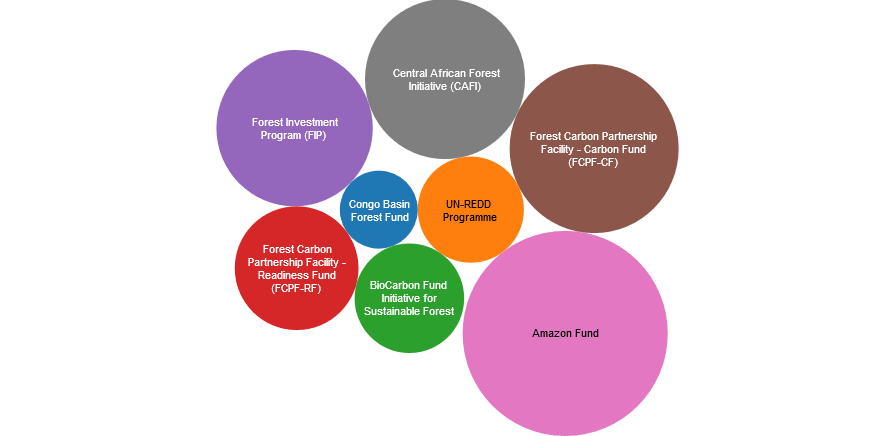
bilateral initiatives including the Brazilian Amazon Fund, Congo Basin Forest
Fund, Forest Carbon Partnership Facility and Forest Investment Program. In order to avoid ‘double counting’, funds
monitored elsewhere on the CFU will be excluded from ICFI data on this page.
Basic Description
|
Name of Fund |
The Government of Norway's International Climate and Forest Initiative (NICFI) |
|
Official Fund Website |
|
|
Date Created |
Date fund proposed: December 2007 |
|
Proposed Life of Fund |
Indefinite |
|
Administrating Organisation |
NICFI's Secretariat, within the Norwegian Ministry of the Environment. |
|
Objectives |
The NICFI aims to:
2. Take early action to achieve cost-effective and verifiable reductions in greenhouse gas emissions.
3. Promote the conservation of natural forests to maintain carbon storage capacity. |
|
Activities Supported |
The NICFI supports activities that strengthen international cooperation on REDD. It focuses on the development of international finance and support systems through close cooperation with multilateral organisations. Specifically, the NICFI works to establish:
|
|
Conditions & Eligibility |
Multilateral
Channels
Eligibility of projects is subject to each initiatives
project selection criteria.
Generally continued funding from the NICFI is dependent on performance of the bilateral initiatives. |
Access to Funding |
Funding will primarily be provided through the abovementioned established multilateral channels, with certain exceptions for bilateral partnerships. |
Fund Governance
|
Decision Making Structure |
A project
group in the Ministry of the Environment, Department for Pollution
Control, Section for Climate and Energy, has been appointed to implement the NICFI.
The group cooperates closely with the Ministry of Foreign Affairs and other
relevant ministries, and draws on climate- and forest-related expertise from multilateral
organizations, NGOs and research institutions. A broad-based inter-ministerial
coordinating group of approximately 12 members has also been appointed. |
Non-Government Stakeholder Participation |
A key component of NICFI's funding portfolio is the Civil Society Support Fund, which supports civil society input to climate change negotiations and REDD+ activities. In 2010, this Civil Society Support Fund received USD$27 million to generate and disseminate scientific knowledge, strengthen civil society's ownership of REDD+, promote informed debate on REDD+, and enhance capacity for stakeholder participation within REDD+. |
|
Information Disclosure |
The Norwegian Government, and by extension, the NICFI, report regularly to the United Nations Framework Convention on Climate Change (UNFCCC). |
|
Issues Raised |
According to a 2010 independent evaluation by LTS International, media and public response to the NICFI has been positive. However, questions were raised about the coherence of various aspects of Norwegian finance. |
Relationship with Official Development Assistance
|
Inclusion as Official Development Assistance? |
Yes. |
|
Financial Instrument/ Delivery Mechanism Used (e.g. grant, loan) |
The NICFI is primarily grant-based (although some funding may be disbursed as loans e.g. funds channelled to the FIP) |
|
Nature of Recipient Country Involvement |
Country partnerships under NICFI are viewed as opportunities to demonstrate that genuine north-south climate change partnerships based on mutual commitments, mutual trust and constructive dialogue are possible. |