Summary
Graphs and statistics
Basic Description
|
Name of Fund |
Least Developed Countries Fund | ||||||||||||||||||||
|
Date created |
Date fund proposed: At the seventh session of the Conference of the Parties to the UN Framework Convention on Climate Change held in Marrakesh, from October 29 to November 10, 2001, (COP7) the GEF, as a financial mechanism of the Convention, was requested to operate two new funds related to the UN Framework Convention on Climate Change (the Special Climate Change Fund and the Least Developed Countries Fund). Date fund made operational: At the eighth session of the COP in October 2002, the GEF reported on the arrangements that had been made for the establishment of the funds. | ||||||||||||||||||||
|
Administrating organisation |
Global Environment Facility (GEF) with World Bank as Trustee. | ||||||||||||||||||||
|
Objectives |
The Least Developed Countries Fund (LDCF) was established under the United Nations Framework Convention on Climate Change (UNFCCC) at its seventh session in Marrakech and is managed by the Global Environment Facility (GEF). The fund addresses the needs of the 49 LDCs which are particularly vulnerable to the adverse impacts of climate change. As a priority, the LDCF supports the preparation and the implementation of the National Adaptation Programs of Action (NAPAs), which are country-driven strategies that identify the immediate needs of LDCs in order to adapt to climate change. | ||||||||||||||||||||
|
Donor contributions |
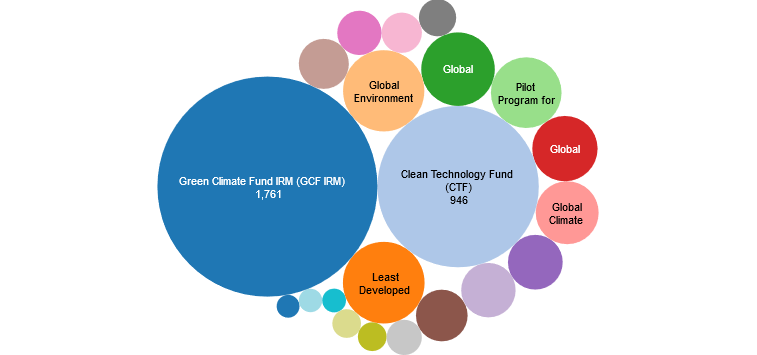
Deposited: As of January 2012, the total amount deposited is USD eq. 368.44 million. See table below for further details: Source: Status Report on the LDCF and SCCF November 2011 Council Meeting | ||||||||||||||||||||
|
Activities supported |
The activities supported by the LDCF are divided in two phases: preparation and implementation of the National Adaptation Programmes of Action (NAPAs). The preparation phase provides a process for Least Developed Countries (LDCs) to identify priority activities that respond to their urgent and immediate needs to adapt to climate change. The steps for the preparation of the NAPAs include synthesis of available information; participatory assessment of vulnerability to current climate variability and extreme events and of areas where risks would increase due to climate change; identification of key adaptation measures as well as criteria for prioritizing activities; and selection of a prioritized short list of activities. The development of a NAPA also includes short profiles of projects and/or activities intended to address urgent and immediate adaptation needs of LDC Parties. In the second phase, after the NAPA official report is finalized and made public, the LDCF will support the implementation of the activities identified, and of other elements of the LDCs work programme. These activities promote the integration of adaptation measures in national development and poverty reduction strategies, plans or policies, with a view to increasing resilience to the adverse effects of climate change. The NAPA implementation phase includes the design, development, and implementation of projects on the ground. Throughout the implementation phase, projects are monitored to measure progress, and at project completion, a final evaluation is required to assess the effectiveness of the measures implemented. The implementation phase should also include a provision for involving a comprehensive and open group of stakeholders. The implementation phase requires not only the mobilization of significant additional resources but also the identification and involvement of key agencies, individuals, communities and entities with relevant expertise to address the problems given priority in the NAPA report. | ||||||||||||||||||||
|
Conditions and eligibility requirements |
All Least Developed Countries are eligible. However, proposals submitted for funding under the LDCF are reviewed in light of agreed project criteria, drawn from the COP guidance. These criteria include country ownership; program and policy conformity; financing; institutional coordination and support; and monitoring and evaluation. For purposes of the LDCF, these criteria are understood as follows: (a) Country ownership includes two considerations: country eligibility and country "driven-ness". For a country to be eligible to receive funding for NAPA implementation under the LDCF, it should be an LDC Party to the UNFCCC that has completed its NAPA. In terms of country "driven-ness", the project proposal should be identified as a priority activity in the country’s NAPA; it should show evidence of stakeholder consultation and support; and it should take into account other relevant local, national or regional studies and projects. (b) Program and policy conformity includes four aspects: program conformity; project design; sustainability and stakeholder involvement. In terms of program conformity, the project document should demonstrate that the proposal has been developed in compliance with the NAPA rules and procedures and represents a response to an urgent and immediate adaptation need. With respect to project design, the proposal should include a list and description of project components as well as an additional cost calculation that demonstrates what would be done in a development baseline in the absence of climate change and the alternative scenario including measures that meet urgent and immediate needs that justifies the request for LDCF resources. In terms of sustainability, the benefits of the project, in this case increased capacity to cope with adverse impacts of climate change, should continue after project completion. Finally, with respect to stakeholder involvement, the project should provide for multi-stakeholder consultations and participation—which have proven pivotal to the NAPA preparation process—to continue during project implementation. (c) Financing refers both to the development and inclusion of a financing plan and an assessment of cost-effectiveness. A financing plan should provide a summary of financing contributions to the project, including an assessment of the baseline financing being included in the project. Co-financing may include utilization of existing resources, in the form of bilateral grants, IDA loans, or other in-cash and in-kind contributions. These co-financing contributions may include existing budget lines of the core development sector under consideration. The total project cost will be the sum of the LDCF contribution and all co-financing. With respect to cost-effectiveness, the project proposal should include a discussion of the various options considered to achieve the project’s goal in a way that demonstrates that the adaptation measures and activities selected represent the most cost-effective approaches. (d) Institutional coordination and support is required of all projects to ensure that any potential duplication of activities is minimized and that coordination, collaboration, and consistency of approaches to other activities in the country is maximized. It is important that NAPA implementation builds upon other ongoing and upcoming activities. (e) Monitoring and evaluation requirements for the project are the same as for all GEF projects. By the time of project approval, all projects should have developed a detailed monitoring and evaluation plan that includes provision and arrangements for annual monitoring reports and independent mid-term and final evaluations. In addition, indicators for tracking the achievement of project goals and objectives should be provided, including targets for mid-term and project completion. The baseline year or “pre-project” values for these indicators should be estimated at the time of project approval. | ||||||||||||||||||||
|
Funds disbursed to date |
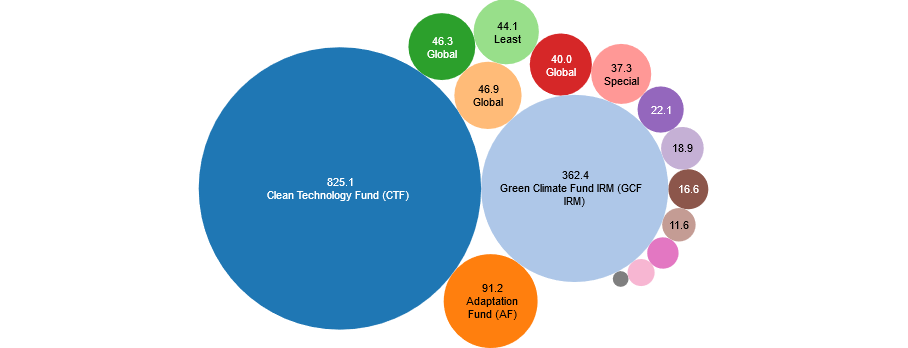
Total amount approved: USD 186.47 million, of which USD 16.95 million for agency fees, total disbursed: USD 115.21 million, based on the GEF LDCF Project Listing found here http://www.gefonline.org/. This listing, which provides detail at the project level, has been used to update the CFU database as at January 2012, using the classifications of approved and disbursed used by CFU, outlined at the bottom of this section. All GEF projects including LDCF and SCCF, are subject to a flat 10% agency fee, which is paid on top of the project grant. This covers the services of the implementing agencies (UNDP, UNEP, IFAD, FAO, WB and others) in assisting the countries in preparing and implementing the project. The full amount, (project grant, project preparation grant and associated 10% agency fees) is paid by the LDCF and SCCF. Source: http://www.gefonline.org/ Please note there has been a slight change in the methodology used by CFU to calculate the amount disbursed for the GEF Trust Fund. Previously, due to lack of accurate data, it was assumed that: - The amount ‘approved’ was equal to the amount ‘disbursed’ - The amount was considered ‘approved’ from the first step of the project cycle (PPG Approved, CEO PIF Clearence, PIF Approved).
As of February 2011, the data has been clarified. The funds approved and disbursed are based on the following classification:
1. PPG Approved: Project Preparation Grant. A Project Preparation Grant (PPG) is a small amount of funds that can be utilized to cover partial project preparation costs incurred by the project proponent. This corresponds to the CFU category ‘Not yet approved’.
2. CEO PIF Clearence: it is a temporary status attached to the Full Size Project (FSP) PIFs (those that will eventually be 'Council Approved'). When a FSP PIF is cleared by the GEF CEO, it is posted for 4 weeks for Council approval. During this 4 week review period, the project is 'PIF cleared' - while it awaits official Council approval. This corresponds to the CFU category ‘Not yet approved’.
3. PIF Approved: Project Identification Form. A Project Identification Form (PIF) is a short description of a project concept that is used by the GEF to determine whether or not the project meets certain basic criteria. If these criteria are met, the project is included in the GEF pipeline. However this corresponds to the CFU category ‘Not yet approved’ since at this stage the money has not yet been earmarked.
4. Council Approved: The project concept has been presented and approved by the GEF Council, and money has been earmarked for the project, under the condition that the project proposal will be fully developed over the next 18 months. Given that practically 100% of Council Approved projects go through to CEO Endorsement, it is safe to consider this funding as approved for eventual disbursement. There is written documentation which confirms Council approval. This corresponds to the CFU category ‘Approved’.
5. CEO Endorsed (or CEO Approved): It triggers the signing and sending of a letter to the Trustee (the WB) that the project is fully approved, and the funds can be released to the IA on request of the IA. The funds are no longer legally under the control of the GEF Trust Fund, but rather ownership has been transferred to the IAs, even if they have not yet drawn down on these funds. Once the funds are made available to the IAs through the Trustee, the funds cannot be drawn back by the GEF. This indicates that the funds have been ‘released’ from the GEF and can be considered disbursed from the GEF (though not necessarily disbursed to a project). This corresponds to the CFU category ‘Disbursed’.
6. IA Approved: Implementing Agency approved. Once the CEO has endorsed the project, the IA’s need to approve the project internally and take the project to the IA Board for approval. Once approval occurs, the IA will (usually) indicate this approval to the GEF and GEF will label the project as ‘IA Approved’ – this process is not under the control of the GEF. This corresponds to the CFU category ‘Disbursed’.
7. Under implementation, Project Closure and Project Completion: they show the different stages of the projects funded, therefore they all fall under the CFU category ‘Disbursed’. | ||||||||||||||||||||
|
Uptake and projects supported |
As of January 2012, there are 99 approved projects. Of these, 87 have had funds disbursed towards them. For a full list of projects, click here. | ||||||||||||||||||||
|
Proposed life of fund |
Unknown | ||||||||||||||||||||
|
Further information |
1. GEF web page for the Least Developed Countries Fund 2. UNFCCC web page for the Least Developed Countries Fund 3. Accessing resources under the Least Developed Country Fund" document http://www.thegef.org/gef/node/4433 |
Fund Governance
|
Decision-making structure for fund disbursement |
The Global Environment Facility (GEF) is the managing body of the SCCF and LDCF funds. GEF’s operational policies, procedures and governance structure are applied to these funds. Its governing structure is composed of: the Assembly, the Council, the Secretariat, ten Agencies, a Scientific and Technical Advisory Panel (STAP), and the Independent Office of Monitoring and Evaluation. For purposes of the LDCF, the GEF functions under the guidance of the Conference of the Parties to the United Nations Framework Convention on Climate Change (COP). For decision making purposes the GEF Council meets as the Council for the LDCF and the SCCF (hereinafter referred to as the LDCF/SCCF Council). Any GEF Council Member is eligible to take part in the LDCF/SCCF Council and may choose to participate or to attend as an observer. The policies and procedures and the governance structure of the GEF apply to the LDCF, unless the LDCF/SCCF Council decides it is necessary to modify such policies and procedures to be responsive to the guidance of the COP. Components of governing structure: The Assembly is composed of all 176 member countries, or Participants. It meets every four years at the ministerial level to review the general policies, operations, membership and potential amendments of the GEF. The GEF Secretariat coordinates the overall implementation of GEF activities. It services and reports to the Assembly and the Council. The Secretariat is headed by the Chief Executive Officer (CEO), who is appointed to serve for three years, and may be reappointed by the Council. The GEF Agencies are the operational arm of the GEF. The GEF develops its projects through ten Implementing Agencies: the United Nations Development Programme (UNDP), the United Nations Environment Programme (UNEP) the World Bank, the African Development Bank (AfDB), the Asian Development Bank (ADB), the European Bank for Reconstruction and Development (EBRD), the Inter-American Development Bank (IAD), the International Fund for Agricultural Development (IFAD), the United Nations Food and Agricultural Organization (FAO), and the United Nations Industrial Development Organization (UNIDO). The Scientific and Technical Advisory Panel (STAP) provides independent advice to the GEF on scientific and technical aspects of programs and policies. The members of STAP are appointed by the Executive Director of UNEP, in consultation with the GEF’s CEO, the Administrator of UNDP, and the President of the World Bank. The Independent Office of Monitoring and Evaluation (M&E) provides a basis for decision-making on amendments and improvements of policies, strategies, program management, procedures and projects; promotes accountability for resource use against project objectives; and documents and provides feedback to subsequent activities, and promotes knowledge management on results, performance and lessons learned. The GEF Focal Points (Country Representatives) are government officials, designated by member countries, responsible for GEF activities and to ensure that GEF projects are country-driven and based on national priorities. The complete list of GEF Focal Points, including name, position, government agency, complete address, phone, fax and e-mail, can be accessed at: http://www.thegef.org/gef/focal_points_list The Project partners are organizations and entities implementing projects on the ground, including governments, national institutions, international organizations, local communities, non-governmental organizations, academic and research institutions and private sector entities. The project cycle of full-size projects can be summarized by the following steps:
|
|
Consultations with non-government stakeholders |
The LDCF follows the public involvement policy http://www.thegef.org/gef/LDCF_Involvement approved by the GEF Council in 1996 and is consistent with the provision of the Instrument for the Establishment of the Restructured GEF [http://www.thegef.org/gef/instrument], which sets explicitly the need for public involvement, the basic provisions of which state that all GEF-financed projects will “provide for full disclosure of non-confidential information, and consultation with, and participation of, as appropriate, major groups and local communities throughout the project cycle.” (p. 12, Basic Provisions, paragraph 5). In addition, the Programming Paper for Funding the Implementation of NAPAs under the LDC Trust Fund further explicitly requires stakeholder consultation in the formulation of NAPAs and subsequent project implementation, which is supportive of high local involvement. Indeed, stakeholder consultations are the central feature of NAPAs, as clearly indicated in the Annotated Guidelines for the Preparation of National Adaptation Plans of Action [http://unfccc.int/files/cooperation_and_support/ldc/application/pdf/annguide.pdf] which stipulate that the participation of men and women at the grassroots-level is essential for providing input on prioritization of actions on impacts affecting their communities, as well as current coping strategies that the NAPA seeks to enhance, following COP 7 Decision 28. The guidelines also stipulate that “[o]pportunities for the involvement of the private sector, NGOs and civil-society organizations should be sought” and recognize that the “engagement of people at the grassroots level will be important in ensuring successful implementation of NAPA activities.” Furthermore, stakeholder consultations are one of the ten guiding principles of NAPAs. The above is reflected in the PIF and CEO Endorsement Request Forms for LDCF, where both have sections requiring input on stakeholder involvement. Therefore, this information is available for each project in the PIF and full project documents, which are available in the GEF Project Database [http://www.gefonline.org/]. Furthermore, the LDCF operates through GEF’s ten Implementing Agencies and this means that the projects funded by these funds are further subject to the rules and operational policies that govern those Agencies, and this includes the Agencies’ rules and policies on local stakeholder involvement. Non Governmental Organizations (NGOs) participate in the GEF NGO Consultation and Council Meeting through the GEF-NGO network. The GEF-NGO Network comprises all accredited NGOs to the GEF. For representation at the Council meetings, the network is divided into regions according to the GEF regional structure. Currently, some 600 NGOs are accredited to the GEF. The network aims to strengthen and influence the work of the GEF at all levels with an aim to integrate NGOs at appropriate levels of decision-making and implementation of programmes and projects in an accountable, transparent and participatory way to ensure a maximum degree of good governance. The GEF-NGO Consultation is a meeting attended by NGOs, the GEF Secretariat, together with the implementing and executing agencies. Council members are also invited to attend. NGOs voice concerns, comment on policies and projects, and present positions on substantive issues. In GEF Council meetings, NGOs can make interventions as observers. The same NGO representative that has been selected to present an intervention during the Consultation will also be responsible for presenting the intervention during the Council meeting. NGOs share their passes to attend the Council meeting, to give everyone the chance to be in the room to make the interventions and follow the discussions. The rest of the NGOs are allowed to follow the discussions through TV circuit in the observer’s room. |
|
How fund disbursement is reported |
All active LDCF projects can be viewed using the GEF project listing tool http://www.gefonline.org/, searching with LDCF as funding source. Disbursements are also reported in the twice-yearly "STATUS REPORT ON THE LEAST DEVELOPED COUNTRIES FUND AND THE SPECIAL CLIMATE CHANGE FUND" reports, which can be found on the GEF website (see link above). |
|
Issues raised by the public |
According to Mitchell, Anderson and Huq (2008), the GEF has not prioritized the adaptation needs of the most vulnerable and has disproportionately funded projects in countries that have relatively low rates of poverty. The authors also list further criticisms by donors and eligible countries:
Source: Mitchell, Anderson and Huq (2008). Principles for Delivering Adaptation Finance. In the paper “Supporting Adaptation to Climate Change: What role for Official Development Assistance?”, the authors outline several criticisms regarding the GEF LDCF and SCCF funds:
Source: Ayres and Huq (2008). Supporting Adaptation to Climate Change: What role for Official Development Assistance?. Available online at: http://www.eed.de/fix/files/doc/DSA%20conf%2008%20paper%20Ayers&Huq1.pdf In Poznam, during the COP14 in December 2008, the least developed countries group expressed their frustration at the speed with which least developed countries are allocated funding for their adaptation activities. According to the Chair of LDC negotiating block, Amjad Abdullah from the Maldives, LDCs had submitted National Adaptation Programmes of Action (NAPA) to the UN convention as requested in 2004; however, NAPA implementation activities have not been funded because of technical and legal problems hampering the operationalization of the Adaptation Fund. Source: http://www.climatemediapartnership.org/spip.php?article570 |
Relationship with Official Development Assistance
|
Is donor funding considered part of official development assistance? |
Yes. |
|
Financial instrument/ delivery mechanism used (e.g. grant, loan) |
Grants. |
|
Nature of recipient country involvement |
Developing countries are members of the GEF council, which is the main governing body of the GEF. In addition, each GEF member country has designated government officials responsible for GEF activities. These officials, known as GEF Focal Points, play a key role in ensuring that GEF projects are country-driven and based on national priorities. There are two types of GEF country Focal Points:
A project has to be endorsed by the country or countries where it will be implemented to be considered to receive GEF funding. The Operational Focal Point is responsible for the endorsement letter, except for global projects. |
|
Overall consistency with the aid effectiveness agenda (i.e. the Paris Declaration) |
National Adaptation Programmes of Action (NAPAs) are intended to promote country ownership. |