Summary
The Clean Technology Fund (CTF) is one of the two (along with the Strategic Climate Fund) multi-donor Trust Funds within the Climate Investment Funds (CIFs). The CIFs have been designed to support low-carbon and climate-resilient development through scaled-up financing channelled through the African Development Bank, Asian Development Bank, European Bank for Reconstruction and Development, Inter-American Development Bank, and World Bank Group. The CTF aims to support the rapid deployment of low-carbon technologies on a significant scale, with the objective of cost-effective reductions in the growth of greenhouse gas emissions.
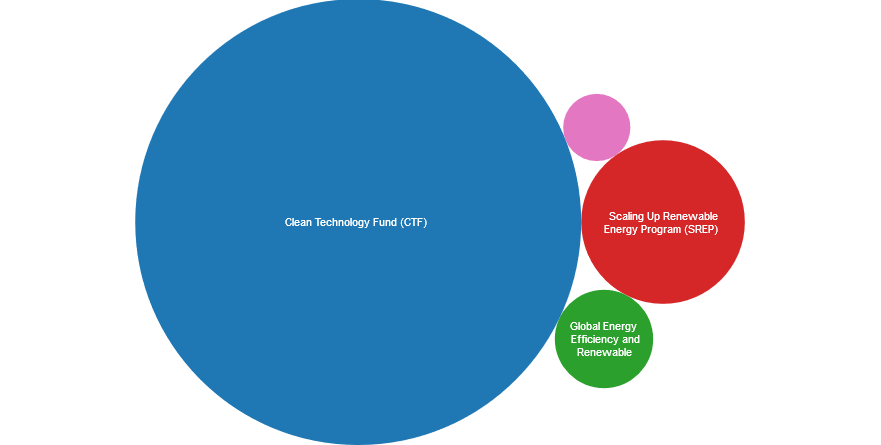
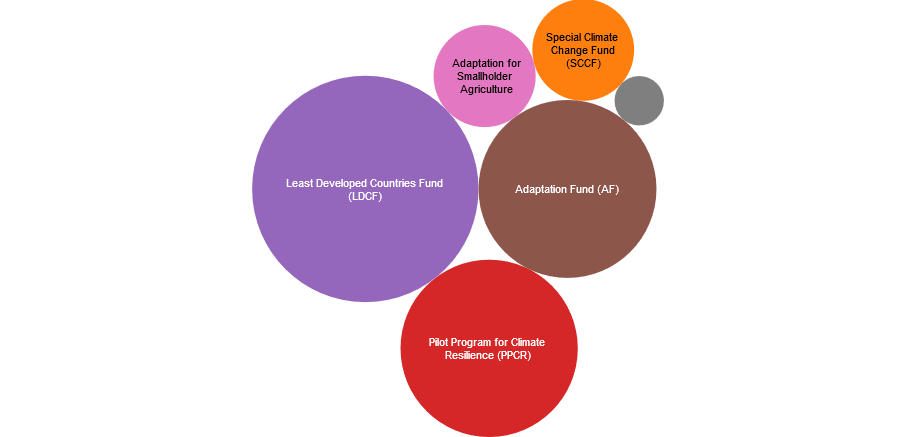
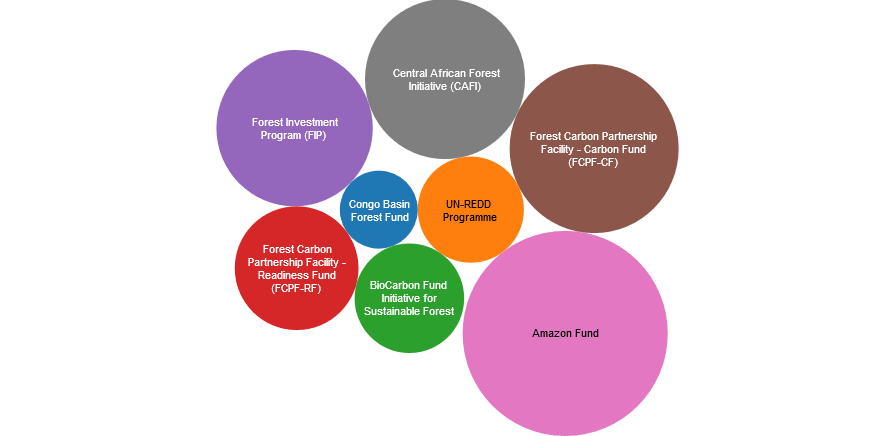
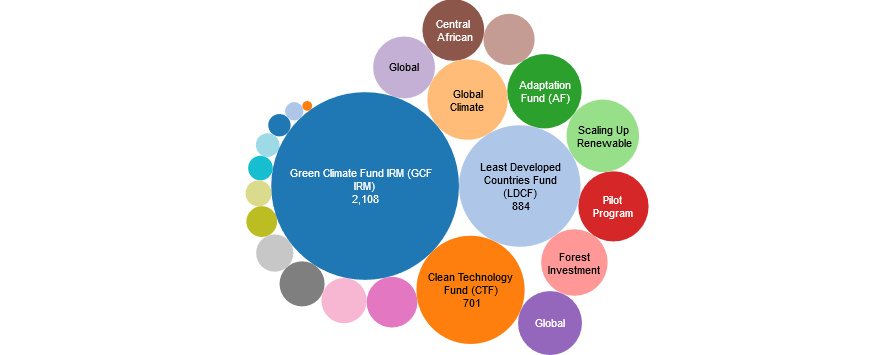
Graphs and statistics
Basic Description
|
Name of Fund |
Clean Technology Fund (CTF) | ||||||||||||||||||||||||||||||||||||||||||||||||||||||||||||||||||||||||||||||||||||||||||||||||||||
|
Date created |
Date fund proposed: February 2008 Date fund made operational: Approved by the World Bank Board of Directors on July 1, 2008 | ||||||||||||||||||||||||||||||||||||||||||||||||||||||||||||||||||||||||||||||||||||||||||||||||||||
|
Administrating organisation |
The World Bank is the Trustee of the CTF Trust Fund. An Administrative Unit for the Climate Investment Funds has been established in the World Bank, in order to (i) manage the meetings of the CIF's Trust Fund Committees and the Strategic Climate Fund (SCF) Sub-Committees, in collaboration with the Multilateral Development Banks; (ii) ensure collaboration and communication among the Multilateral Development Banks and convene meetings of the MDB Committee; and, (iii) promote cooperation with other development partners to advance the objectives of the Climate Investment Funds. The World Bank Group, the African Development Bank, the Asian Development Bank, the European Development Bank, and the Inter-American Development Bank are the implementing agencies for CTF investments. | ||||||||||||||||||||||||||||||||||||||||||||||||||||||||||||||||||||||||||||||||||||||||||||||||||||
|
Objectives |
The Clean Technology Fund (CTF) is one of the two (along with the Strategic Climate Fund) multi-donor Trust Funds within the Climate Investment Funds (CIF). The CIFs have been designed to support low-carbon and climate-resilient development through scaled-up financing channeled through the African Development Bank, Asian Development Bank, European Bank for Reconstruction and Development, Inter-American Development Bank, and World Bank Group. The CTF aims to finance transformational actions by: (a) Providing positive incentives for the demonstration of low carbon development and mitigation of greenhouse gas emissions through public and private sector investments; | ||||||||||||||||||||||||||||||||||||||||||||||||||||||||||||||||||||||||||||||||||||||||||||||||||||
|
Donor contributions |
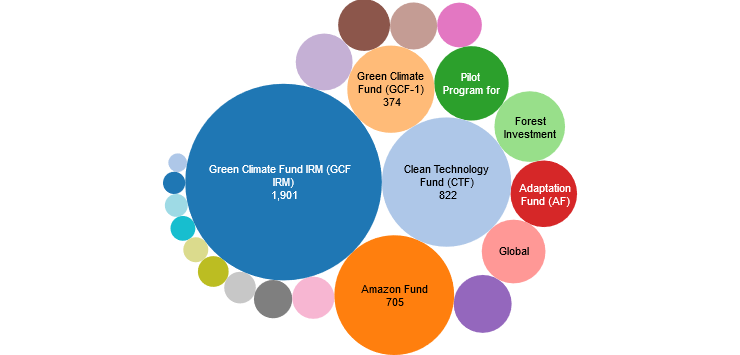
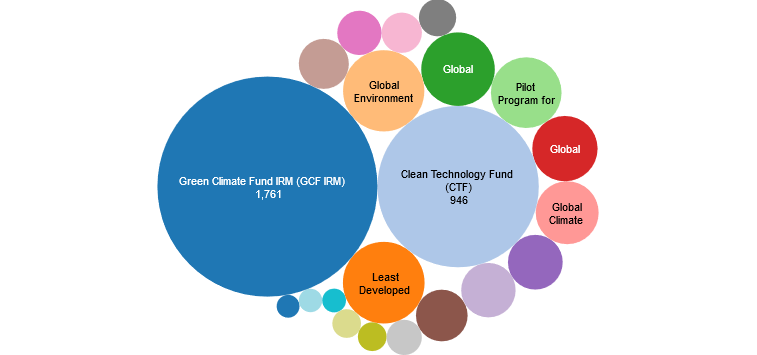
Pledged: The total amount pledged by eight countries to the CTF is USD eq. 4.43 billion as of November 2011. USD 2.824 billion of this was in Grants, and USD 703 million in concessional financing and USD 465 million in capital finance. However as of January 2012 we are lacking information on the latest donor contributions/fund disbursements. Pledges to the Clean Technology Fund (CTF)
* Amount pledged to the SCF and allocated to the CTF.
** Exchange rate as per Trustees Report on Status of CTF, 20 October 2011
Deposited: The total amount deposited by eight countries to the CTF is USD eq. 2.877 billion as of November 2011. However as of January 2012 we are lacking
information on the latest donor contributions/fund disbursements.
Deposits to the Clean Technology Fund (CTF)
*** Converted to USD using exchange rate implied by Trustees Report on Status of CTF, 20 October 2011 | ||||||||||||||||||||||||||||||||||||||||||||||||||||||||||||||||||||||||||||||||||||||||||||||||||||
|
Activities supported |
The Clean Technology Fund will invest in projects and programs that contribute to demonstration, deployment and transfer of low carbon technologies with a significant potential for long term greenhouse gas emissions savings. As country circumstances differ, investment programs will be developed on a country-specific basis to achieve nationally-defined objectives. Options include programs and large-scaled projects:
Potential sectors for CTF investments are in the power sector (renewable energy, as well as increased efficiency in generation, transmission and distribution); transportation (modal shifts to public transportation, improved fuel economy, and fuel switching); and large scale adoption of energy efficient technologies in the industrial, commercial and residential building sectors. | ||||||||||||||||||||||||||||||||||||||||||||||||||||||||||||||||||||||||||||||||||||||||||||||||||||
|
Conditions and eligibility requirements |
Country access will be based on: (a) ODA-eligibility (according to OECD/DAC guidelines); and (b) an active multilateral development bank (MDB) country program. When a country expresses interest in accessing CTF financing, the MDBs concerned will conduct a joint mission involving other relevant development partners. MDBs will engage with government officials, private industry and other stakeholders on how the fund may help finance scaled-up, low carbon activities in the given country. An investment plan will be designed under the leadership of the recipient country. Details of joint missions can be found on the CTF website here http://www.climateinvestmentfunds.org/cif/CTF_Joint_Missions The CTF Trust Fund Committee envisages that resources of the fund should not be spread too thinly if the fund is to achieve its objectives. Therefore, it is expected that fifteen to twenty investment plans for CTF co-financing should be prepared for consideration by the Trust Fund Committee. The investment plan is a “business plan” of the multilateral development banks (MDBs), developed under the leadership of the government, to assist a country with CTF co-financing in implementing its national development strategies and programs with low carbon objectives. The investment plan is agreed among, and owned by, the government and the MDBs. Investment criteria for public sector operations have been approved, and can be accessed here: http://siteresources.worldbank.org/INTCC/Resources/CTFInvestmentCriteriarevisedcleanJan16.pdf
The CTF determines a project’s eligibility and the level of financing on the basis of whether it will have a “transformative” effect by supporting programs that would not have been viable without concessional finance. One component of this approach assesses the potential impact of CTF financing on the risks and costs of deploying clean technologies. CTF programs are intended to “stimulate lasting changes in the structure or function of a sub-sector, sector or market” and “demonstrate how CTF co-financing could be used, possibly in combination with revenues from emissions reductions, to make low GHG emissions investments financially attractive by improving the internal rates of return on such investments. | ||||||||||||||||||||||||||||||||||||||||||||||||||||||||||||||||||||||||||||||||||||||||||||||||||||
|
Funds disbursed to date |
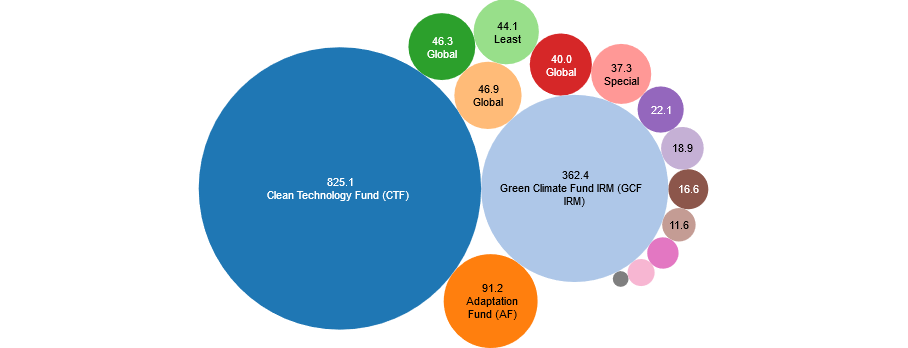
Cumulative disbursements as of January 2012 were USD 384 million, including USD 22 million on administrative expenditure. At the CTF Steering Committee meeting in November 2010, members inquired about the cumulative level of disbursement of the funds and the need for transparent information about this. The Trustee explained that it does not disburse by project; rather it disburses by lump sum to the multilateral development banks (MDBs) who implement the projects, and then the MDBs disburse it on to direct projects. Therefore CTF will need to collaborate with the MDBs to introduce monitoring of disbursement. A process to integrate their monitoring systems with those of the other MDBs is getting underway. | ||||||||||||||||||||||||||||||||||||||||||||||||||||||||||||||||||||||||||||||||||||||||||||||||||||
|
Uptake and projects supported |
The Fund has moved into implementation phase. As of January 2012, the Trust Fund Committee has endorsed 14 Investment Plans for a pipeline of 60 planned projects amounting to USD 4.60 billion in CTF funding. Endorsed investment plans include the following:
These endorsed Investment Plans, totaling USD 4.60 billion, are projected to leverage an additional USD 37.56 billion in co-financing. Of the endorsed investment plans, the Trust Fund Committee has approved 34 projects as of January 2012, totaling USD 1.937 billion. Details of these projects can be found in the 'Projects' and 'Decisions by mail' sections of the CTF website http://www.climateinvestmentfunds.org/cif/node/2 | ||||||||||||||||||||||||||||||||||||||||||||||||||||||||||||||||||||||||||||||||||||||||||||||||||||
|
Proposed life of fund |
The design of the CTF includes a “sunset clause” stating that "the CTF will take necessary steps to conclude its operations once a new [UNFCCC] financial architecture is effective." Any funds remaining in the CTF once this new architecture has been established may be transferred to “another fund that has a similar objective”. If the UNFCCC negotiations result in a renewed mandate for the CTF, operations may continue with appropriate adjustments in priorities or programs. | ||||||||||||||||||||||||||||||||||||||||||||||||||||||||||||||||||||||||||||||||||||||||||||||||||||
|
Further information |
For general information, meeting documents, governance framework, Trustee reports, investment criteria, operations summaries, and annual reports, visit: http://www.climateinvestmentfunds.org/cif/node/2 Nakhooda, Smita (November 2010) 'Clean Technology Fund: Insights for Development and Climate Finance' WRI Working Paper. World Resources Institute, Washington, D.C. http://www.wri.org/publication/clean-technology-fund-insights-for-development-and-climate-finance |
Fund Governance
|
Decision-making structure for fund disbursement |
The governance and organizational structure of the CTF includes the CTF Trust Fund Committee, a MDB Committee, a Partnership Forum, an Administrative Unit and a Trustee. A brief summary of these groups is given below, and full descriptions of their respective responsibilities can be found on the CTF website here http://www.climateinvestmentfunds.org/cif/CTF_Governance CTF Trust Fund Committee: The CTF Trust Fund Committee was established to oversee and decide on the operations and activities of the CTF. Committee composition:
Representatives from contributor and eligible recipient countries are decision making members, and serve for a two year term. Terms are staggered so that not all Members are replaced each year. If there are less than eight donor countries contributing to the CTF in the a given year, the number of donor country representatives and recipient country representatives, respectively, shall be reduced to equal the number of actual donors contributing to the CTF. Representatives may be reappointed. MDB Committee: The Multilateral Development Banks (MDB) Committee facilitates collaboration, coordination and the exchange of information, knowledge, and experience among MDB partners. Partnership Forum Administrative Unit: The Administrative Unit supports the work of the CIF, the Trust Fund Committee and other committees. It is housed in the World Bank Group’s Washington, DC offices and is comprised of a small professional and administrative staff. Trustee: The World Bank (International Bank for Reconstruction and Development) acts as Trustee for all Climate Investment Funds, including the CTF. It holds in trust, as a legal owner and administrator, the funds, assets and receipts that constitute the Trust Fund, pursuant to the terms entered into with the contributors. |
|
Consultations with non-government stakeholders |
In designing the Climate Investment Funds, consultations took place with potential donors and recipients, the United Nations family, other multilateral development banks (MDBs), civil society organizations, and the private sector. At a final design meeting, held in Potsdam, Germany, on May 21-22, 2008, representatives from some 40 developing and industrialized countries agreed to create the CIF. The Fund includes a Partnership Forum – a broad-based meeting of stakeholders, including donor and eligible recipient countries, MDBs, UN and UN agencies, GEF, UNFCCC, the Adaptation Fund, bilateral development agencies, NGOs, private sector entities, and scientific and technical experts. The group will be convened annually to provide a forum for dialogue on the strategic directions, results and impacts of the CIF. The Partnership Forum will be co-chaired by the World Bank Vice President for the Sustainable Development Network and a country representative elected by countries participating in the Partnership Forum. The Partnership Forum will be a meeting for dialogue and consultation and will not lead to written outcomes, such as agreed texts or declarations, which could be used as a basis for discussions in the UNFCCC. A number of stakeholders are observers to the deliberations of the CTF committee, including the secretariat of the UN Framework Convention on Climate Change (UNFCCC) and the Global Environment Facility (GEF). Two representatives of the private sector or business associations (one from a recipient country and one from a contributor country) and four representatives of civil society are also included as observers. These observers have been appointed through a processes of “self selection” coordinated by the World Business Council for Sustainable Development for the private sector, and by the Washington, DC based NGO Resolve for civil society in 2009. All observer roles are “active”, which allows them to request the floor to make interventions, propose agenda items, and recommend experts. The World Bank and its partners periodically host a “Partnership Forum” to share lessons learned from the CIF with a range of stakeholders, and to seek expert input Programs. The first forum was held in October 2008, and the second in March 2010. More details about the current composition of observers, along with their formal roles and responsibilities, can be found on the CTF website here http://www.climateinvestmentfunds.org/cif/CTF_Observers However, not all sessions of the CTF committee meetings are open to observers. Deliberations over investment plans are at present closed “executive sessions”. As administrator of the fund, the World Bank has sought to ensure that CTF disclosure practice is consistent with its disclosure policy, and hesitated to exceed those standards. In May 2009, the Trust Fund Committee agreed to publicly disclose Clean Technology Plans prior to their meetings. Previously these plans were not disclosed until after they had been approved in principle by the committee. In October 2009, the decision was made to allow observers to attend country and MDB presentations of the investment plans, and provide brief comments. The actual discussion of the plan continues to exclude observers. In November 2009, the civil society and private sector observers made a formal request to the chairs of the CTF trust fund committee to include observers in all sessions of the meetings. |
|
How fund disbursement is reported |
Disclosure policy
In May 2009, the Trust Fund Committees approved a disclosure policy that calls for country-owned investment plans and strategies developed under each of the Trust Funds to be disclosed in-country prior to their submission to a CIF Committee for approval. Proposed plans are also posted on the CIF website no later than 3 weeks prior to review of the proposal by a Committee. In the case of proposed programs and projects, an information document describing the proposal is to be made public at least two weeks prior to a decision on the funding of the proposal. The policy recognizes that a country or a project proposer may have justifiable reasons for not publicly disclosing all information in an investment plan or project. In this case, certain information may be kept confidential. This is to be done only on an exceptional basis, and non-disclosure of information is to be justified to the Committee |
|
Issues raised by the public |
Observers have stressed the need to tackle the policy, institutional and regulatory barriers to low carbon development if the CTF is to fulfil its aim of sustained and transformative impacts. These factors are not currently adequately addressed in CTF analysis or monitoring. There are also calls for efforts to strengthen countries' capacities to produce low carbon technologies themselves.
In an April critique of the Middle East and North Africa plan for concentrated solar power, the Bank Information Center argued that the plan promoted energy for export rather than increased access, involved water-intensive technology in a water-scarce region, and engaged insufficiently with regional civil society. A good overview of the CTF and related issues can be found in: Nakhooda, Smita (March 2010) 'Clean Technology Fund: Insights for Development and Climate Finance' WRI Working Paper. World Resources Institute, Washington, D.C. http://www.wri.org/publication/clean-technology-fund-insights-for-development-and-climate-finance
The MDBs administrative and overhead charges have been a cause of concern for some governments. (http://www.wri.org/publication/clean-technology-fund-insights-for-development-and-climate-finance)
While the US originally pledged $2 billion to the CTF under the Bush administration, the U.S. Congress and Senate did not approve this appropriation in the 2009 budget. This is because several lawmakers, including House Speaker Nancy Pelosi (D-Calif.), opposed the bank's plan to allow some efficient coal-fired power plants to be considered "clean" (for information on the World Bank’s memo describing conditions under which it would use the CTF to finance coal and gas projects, see: CTF Criteria for Financing Low Carbon Opportunities in Coal and Gas Power Investments). The document states that coal power stations may receive CTF financing if they meet or surpass a certain level of efficiency - meaning they must emit less than 0.795 tonnes of carbon dioxide for every megawatt hour of power produced. The World Bank's own data shows that standard coal power stations built in rich nations emit 0.8 tonnes of CO2 per MWh. However, no such project has been approved to date. (For more information, see: http://www.newscientist.com/article/dn16683-green-funding-for-coal-power-plants-criticised.html).
The primary concern raised in a briefing document to the US Congress about the CTF involves the types of “clean” technologies the World Bank may support. Several Members have questioned whether the CTF should be “technology neutral,” thus allowing CTF resources to fund carbon based investments. This was the central debate during a June 5, 2008 House Financial Services Committee hearing on the CTF. (see presentations here: http://www.house.gov/apps/list/hearing/financialsvcs_dem/hr060608.shtml)
Some believe that the CTF Partnership Forum is an inadequate provision for proper inclusion and consultation of civil-society stakeholders.A more formal role for representatives of civil society in the governance of the fund – perhaps as an independent technical expert –would be valuable. (see: http://www.wri.org/publication/us-contributions-world-bank-clean-technology-fund) The Trust Fund Committee approved a proposal for Civil Society representatives to observe meetings of the Trust Fund Committee in January 2009. The CIFs have been criticised by civil society groups for creating parallel structures for financing climate change adaptation and mitigation outside the ongoing multilateral framework for climate change negotiations and within a process dominated by G8 countries. Developing countries have long argued for greater commitments and increases in financial resources under the UNFCCC to enable them to fulfil their obligations under the Convention but have maintained that such resources should be placed under the guidance of the state parties to the Convention to ensure consistency with internationally agreed priorities and principles (See: Celine Tan, Third World Network, ‘World Bank’s Climate Funds Will Undermine Global Climate Action’ 10 April 2008: www.twnside.org.sg/title2/finance/docs/Climate.Funds-Commentary.Revised.doc). The CIFs are also criticised for the significant speed at which they have been designed, promoted and implemented without due consultation with wider stakeholders. (See: Celine Tan, Third World Network, ‘No additionality, new conditionality: a critique of the World Bank’s Climate Investment Funds’ Briefing Paper 2, 2008: www.foe.org/pdf/CIF_TWNanalysis.pdf). The language of the Fund has been criticised for implying recognition of the UNFCCC principles as merely guidance for the Fund’s policies rather than as binding internationally negotiated commitments of state parties which must be respected. It also demonstrates a lack of familiarity with the principles negotiated under the Convention and the legal status of commitments under the UNFCCC (see: http://www.twnside.org.sg/title2/finance/twninfofinance20080510.htm). |
Relationship with Official Development Assistance
|
Is donor funding considered part of official development assistance? |
Since CIF is a pooled multi-donor trust fund managed by the World Bank, an international development institution recognized as such by the DAC for the purpose of ODA eligibility, these contributions can be scored as multilateral ODA. The outgoing use of all CIF resources as concessional loans, grants, and guarantees through the MDBs can be reported by each MDB as ODA if: (a) it meets the criterion of promoting economic development and welfare; b) the grant element is at least 25 percent; and c) funds are to be used in a country included in DAC list of ODA eligible countries. | ||||||||||||||||||||||||
|
Financial instrument/ delivery mechanism used (e.g. grant, loan) |
The CTF uses a blend of financial instruments, including grants, concessional loans and guarantees to make investing in low carbon technologies more attractive to both public and private sector investors in developing countries. It is also a collaborative effort between the World Bank and other MDBs, through an investments plan for each country of operation prepared under the leadership of the country government. The CTF, through the MDBs will seek to:
CTF financing will provide a grant element tailored to cover the identifiable additional costs of the investment necessary to make the project viable, thereby providing the appropriate incentive to facilitate deployment of low carbon technologies at scale. The share of funding allocated to an MDB will be based on country requests, the quality of proposals, the comparative advantage of the MDB and experience in a region/country. The MDBs will rely on their own policies and procedures in developing and managing activities that the CTF will finance, and report directly to the CTF Trust Fund Committee on operational matters. The MDBs will be invited to present their views on items under consideration by the CTF Trust Fund Committee. The terms of CTF financing are as follows:
Source: Climate Investment Funds 'Clean Technology Fund Financing Products, Terms, and Review Procedures for Public Sector Operations', May 28, 2009. | ||||||||||||||||||||||||
|
Nature of recipient country involvement |
A selection of eight eligible recipient countries will participate in the CTF Trust Fund Committee as voting members. A selection of eligible recipient countries (matching in number of contributor countries) will participate in the SCF Sub-Committee and participate as voting members. Whenever the Trust Fund Committee considers an investment plan for a country or a program or project to be financed by the fund, the recipient country concerned will be invited to participate in the Trust Fund Committee during its deliberations on the work program, program or project. Recipient countries will also be invited to the Partnership Forum meeting of stakeholders, which does not have voting members nor written outcomes and only serves as a forum for dialog and discussion. | ||||||||||||||||||||||||
|
Overall consistency with the aid effectiveness agenda (i.e. the Paris Declaration) |
The CTF investment plan must align with recipient countries’ national development plans, and must take account of on-going MDB operations in key sectors or sub-sectors in the country. It is envisaged that the government will play a central role in programming of the CTF’s public sector related projects and in donor coordination. The CTF document states ‘Activities financed by the fund should be based on a country-led approach and should be integrated into country-owned development strategies, consistent with the Paris Declaration’. |